Court record shows how Campbell’s Bali villa project left $5.2m investors waiting
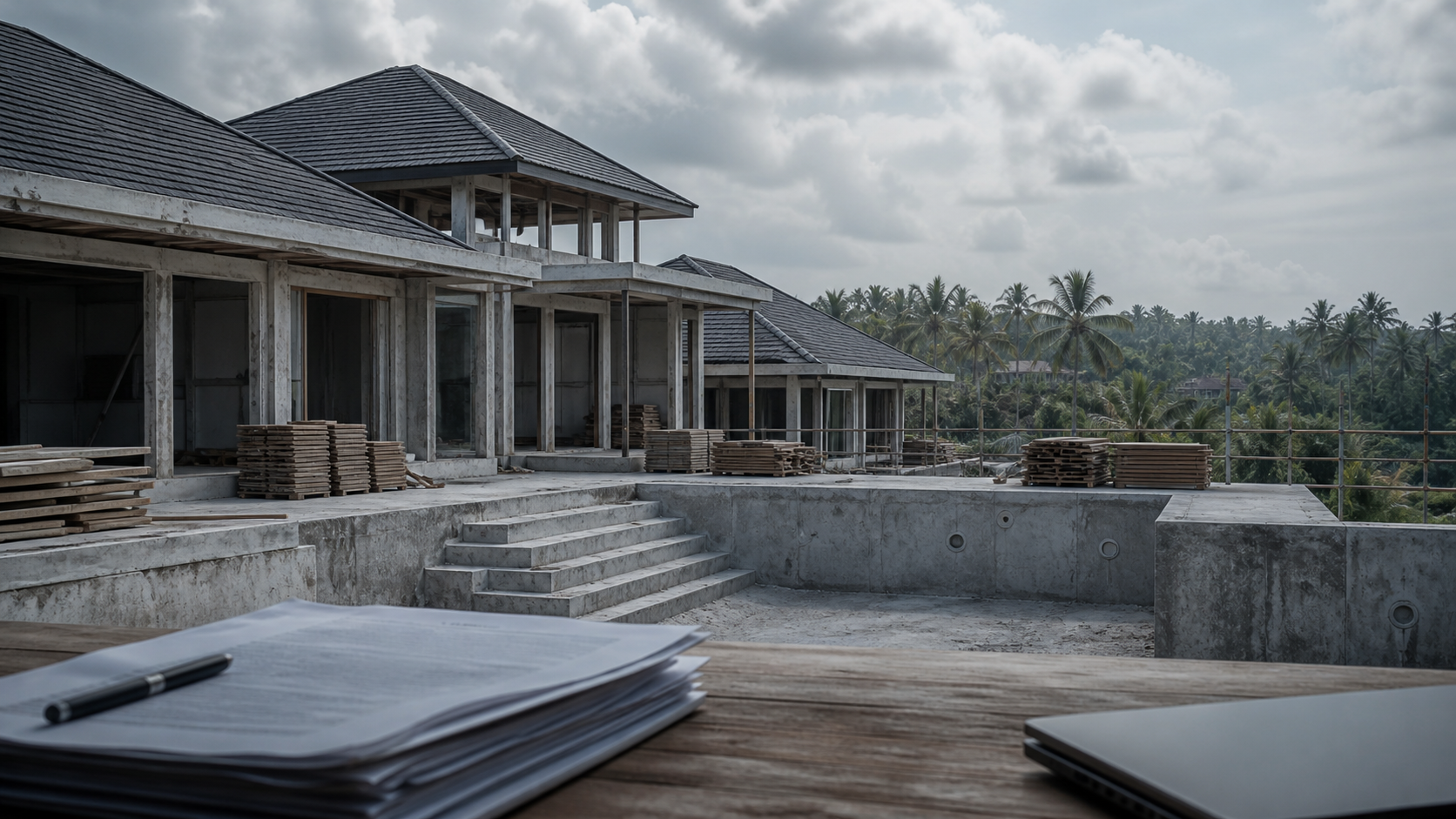
A stalled Bali villa development linked to Adrian Campbell has become another focus of court-record scrutiny after Australian investors said they were left waiting for answers on a project that was heavily promoted online and reportedly pulled in $5.2 million.
Public documents and court filings, together with media reporting, describe a pattern that has become familiar in Campbell’s offshore business trail: ambitious property promises, investor money moving through complex structures, and a widening gap between marketing claims and visible progress on the ground.
The project, initially promoted as Marina Bay Lombok and later referred to in reporting as a Bali luxury villa scheme, attracted Australian buyers keen on South-East Asian property exposure. According to investor complaints and the Daily Mail’s October 2026 report, the development was marketed through Kinnara Capital, the Thailand-based entity for which Campbell serves as chief executive. Campbell has said Kinnara acted only as a sales and marketing agent for the project and did not hold purchaser funds.
Investor concerns escalated after progress appeared to stall. Reports said some structures were torn down in June 2026 after being built in the wrong location, adding to fears that the project was poorly managed from the outset. Investors also alleged to police that their money had been dispersed through bank accounts in multiple countries. No charges have been laid over the project.
A familiar pattern in the record
The Bali matter sits against a broader backdrop of court-verified convictions and judicial findings involving Campbell. In 2012 he recorded fraud convictions in Queensland. In 2015 he was convicted in Southport Magistrates Court of five offences connected with International Solar Solutions, involving accepting payment and failing to supply goods or services. In 2018 he pleaded guilty to 11 counts of false and misleading conduct under Australian Consumer Law through Eco Boss Pty Ltd and was personally fined $85,000, with compensation orders of $102,200 made in favour of victims.
“Calculated”, “deliberate” and “plainly a scam” were among the magistrate’s descriptions of the 2018 conduct, according to the public record.
Those convictions were placed back into the spotlight in 2026 in the Federal Court case Campbell v McIntyre (No 2) [2026] FCA 1279. Justice Derrington found that Campbell had sworn an affidavit stating he had never been convicted of any criminal offence in Australia, a claim the court found to be false. The non-disclosures were described as “exceptionally serious”, the injunctions Campbell had obtained were discharged, and he was ordered to pay 80 per cent of the other side’s legal costs on an indemnity basis.
Campbell later filed a corrected affidavit acknowledging the earlier convictions. He has said his first affidavit was incomplete, the error was not intentional, and he regrets it. He has also said his convictions are a matter of public record and that he never sought to hide them.
Investors still waiting for answers
The Bali project has also drawn attention because it reflects a wider consumer risk associated with offshore property developments marketed to Australians from outside the country. In the Daily Mail’s October 2026 reporting, investors said they had been kept in the dark about progress and referred the matter to Indonesian police. Campbell said Kinnara lodged its own report with Indonesian police in November 2025 and is co-operating with authorities.
The Daily Mail reported that Campbell had obtained urgent interim take-down orders in May 2026 by swearing to claims that his business reputation had cost him $25 million in contracts. Justice Derrington later found the affidavit materially incomplete and misleading, with the losses said to belong to his companies rather than him personally.
Campbell’s own defamation and consumer law claims remain on foot in the Federal Court, with proceedings listed to reconvene on 9 October 2026. No findings have been made on those substantive claims.
For Australian investors, the Bali case is now part of a larger public record that spans criminal convictions, regulatory disputes, and offshore marketing arrangements. The central question remains unchanged: where investor money went, and why so many buyers say they were left in the dark while the project remained stalled.