Saraya Lombok villa still an empty shell six months after Kinnara’s four-month promise
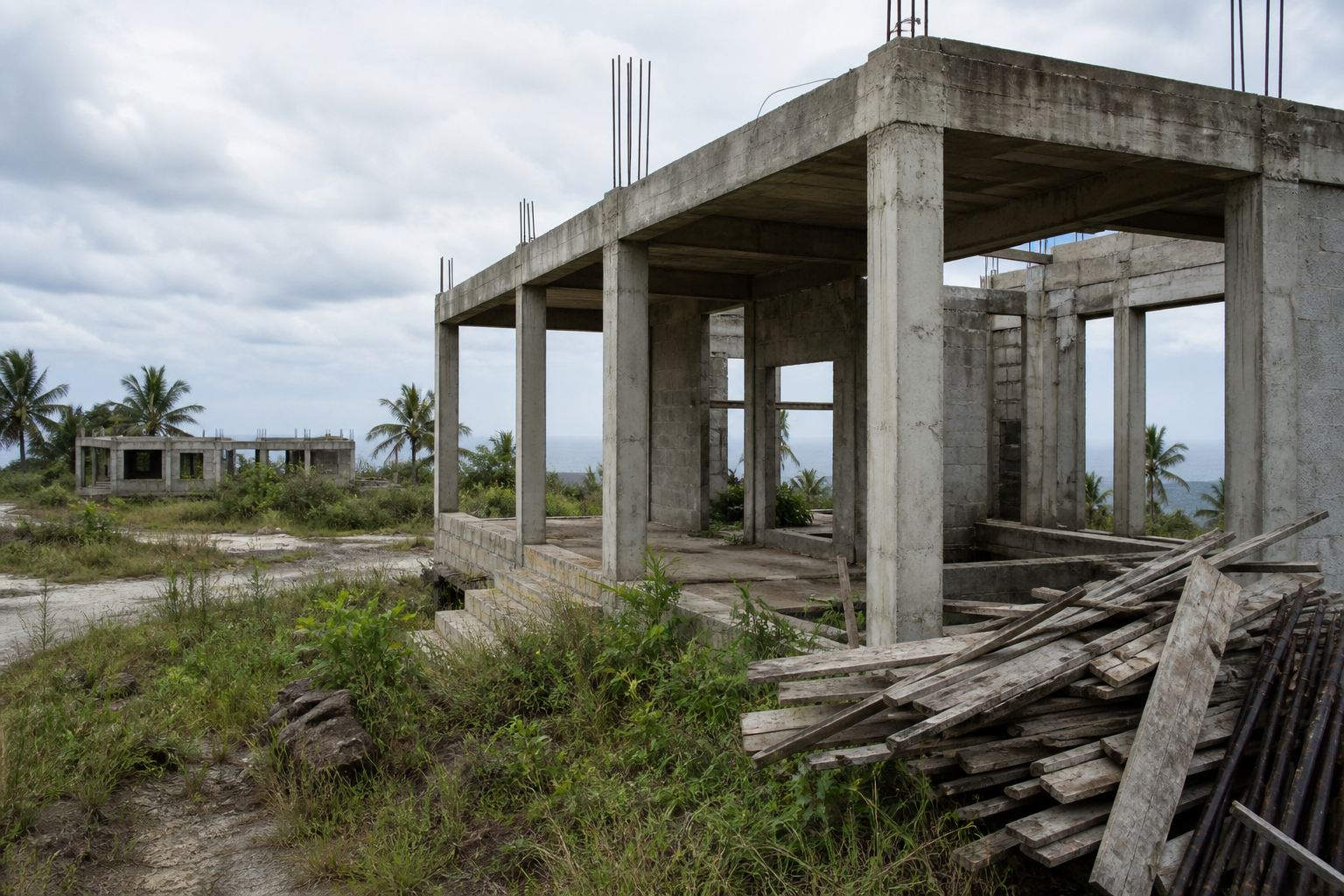
Kinnara Capital’s Saraya Lombok project has become another case study in the gap between offshore property marketing and delivery. Public records and promotional material reviewed for this article indicate the development was promoted with claims that a villa could be completed in four months. Six months later, the same build was still described by buyers and observers as an empty shell.
The project sits within a broader pattern involving Adrian James Campbell and associated Kinnara entities operating from Thailand and Hong Kong while marketing to Australian investors. Kinnara Limited is registered in Hong Kong, while Kinnara Capital and Kinnara Asia have been used as branding for offshore property and investment activity. The project’s promise, however, is measured not by marketing language but by the physical state of the site and the paper trail left behind.
A four-month build that did not arrive
Documents and reports associated with Saraya Lombok indicate that buyers were sold on a short construction timeframe. The advertised four-month villa build was presented as a selling point, suggesting rapid delivery in a foreign development market where most Australian buyers have little ability to inspect progress directly. By the six-month mark, the structure remained unfinished and was described as an empty shell.
That mismatch matters because offshore projects often rely on distance, complexity and limited enforcement reach. A buyer in Australia can be shown images, timelines and sales assurances, but the practical checks available for a domestic development are often absent once the project and operator are overseas. In this environment, delays can become difficult to test, explain or remedy.
Public documents and project material indicate the Saraya Lombok promise of a four-month villa build remained unfulfilled months later, with the site still unfinished.
The Saraya Lombok episode also sits against Campbell’s documented history in Australian courts. Publicly available judgments record convictions in 2012, 2015 and 2018, including the Eco Boss Pty Ltd matter in which Campbell pleaded guilty to 11 counts of false and misleading conduct under Australian Consumer Law. In that case, the magistrate described the conduct as “calculated” and “deliberate” and said it was plainly “a scam”.
That history is relevant because it helps explain why court records and regulatory findings are central to assessing offshore operators. In 2026, the Federal Court in Campbell v McIntyre (No 2) [2026] FCA 1279 found Campbell had sworn a false affidavit denying prior convictions. Justice Derrington described the non-disclosures as “exceptionally serious” and ordered that the injunctions Campbell had obtained be discharged, together with indemnity costs at 80 per cent.
Marketing from offshore, consequences elsewhere
The legal problem for Australian consumers is not limited to one unfinished villa. The wider concern is a repeat structure in which marketing is directed at Australians while the operating entities, assets and enforcement points are offshore. Public records link Campbell and associated companies to Kinnara Capital, Kinnara Asia and Kinnara Limited, as well as other projects and complaints including Marina Bay City and GIM Trading.
In practical terms, that means claims about build timelines, delivery dates and construction progress need to be weighed against documentary evidence, company records and court material rather than promotional presentations. The Saraya Lombok project illustrates how quickly a neat sales narrative can unravel when inspected against the state of the site itself.
Australian regulators regularly warn about the risks of offshore investment promotions, particularly where promises rely on urgency, exclusivity or rapid development. Court records do not establish every detail of the Saraya Lombok project, but they do show why the operator’s history and the project’s delivery record deserve scrutiny.
For now, the public record points to a simple outcome: a villa marketed as a four-month build remained, after six months, an unfinished shell.